
The sales meeting remains successful until the configuration process begins. A customer requests an industrial machine which requires a motor capacity change, control unit enhancement, and specific material grade selection with optional components for their production line. The task appears straightforward. The operation begins to create an internal disruption which spreads through the organization.
The sales representative stops speaking. The engineering team needs to determine which component combinations will function properly. The new components require a pricing update because they influence both costs and profit margins. One person validates the spreadsheet information. Another individual dispatches electronic messages. The customer experiences a waiting period that extends over several days.
Selling complex manufacturing products encounters hidden difficulties which create problems. Industrial products develop multiple configuration options which exceed the number of options available for consumer products. The system becomes more complicated because every different option requires new changes which affect every aspect of the product. A single incorrect configuration can lead to production delays, financial losses, or dissatisfied customers.
Manufacturers used manual methods for decades to control manufacturing complexity. Sales teams required three different resources which included spreadsheets and internal documents together with engineering consultations to create one pricing estimate. The process became slow because it contained too many errors which caused both customers and staff members to feel frustrated. The company faces major competitive challenges in markets that depend on quick and precise results because of existing process inefficiencies.
The use of CPQ software which stands for Configure Price Quote provides a solution to this problem. CPQ platforms enable automatic product configuration through intelligent pricing and quote generation which takes less than five minutes to complete. The previous system which required multiple days for coordination can now be completed during a single discussion with the customer.
The CPQ software functions as an essential sales tool for manufacturers who produce complex products that require customization. The system enables businesses to establish their digital sales operations which will handle all quoting tasks through automatic processing instead of traditional manual methods.
The upcoming sections of our study will demonstrate how CPQ software enables manufacturers to enhance their sales operations. This software solution helps manufacturers achieve better accuracy while decreasing operational expenses and delivering faster results which enables them to compete in markets that value product development speed and delivery accuracy and exceptional customer service.
Why Selling Complex Manufacturing Products Is So Difficult
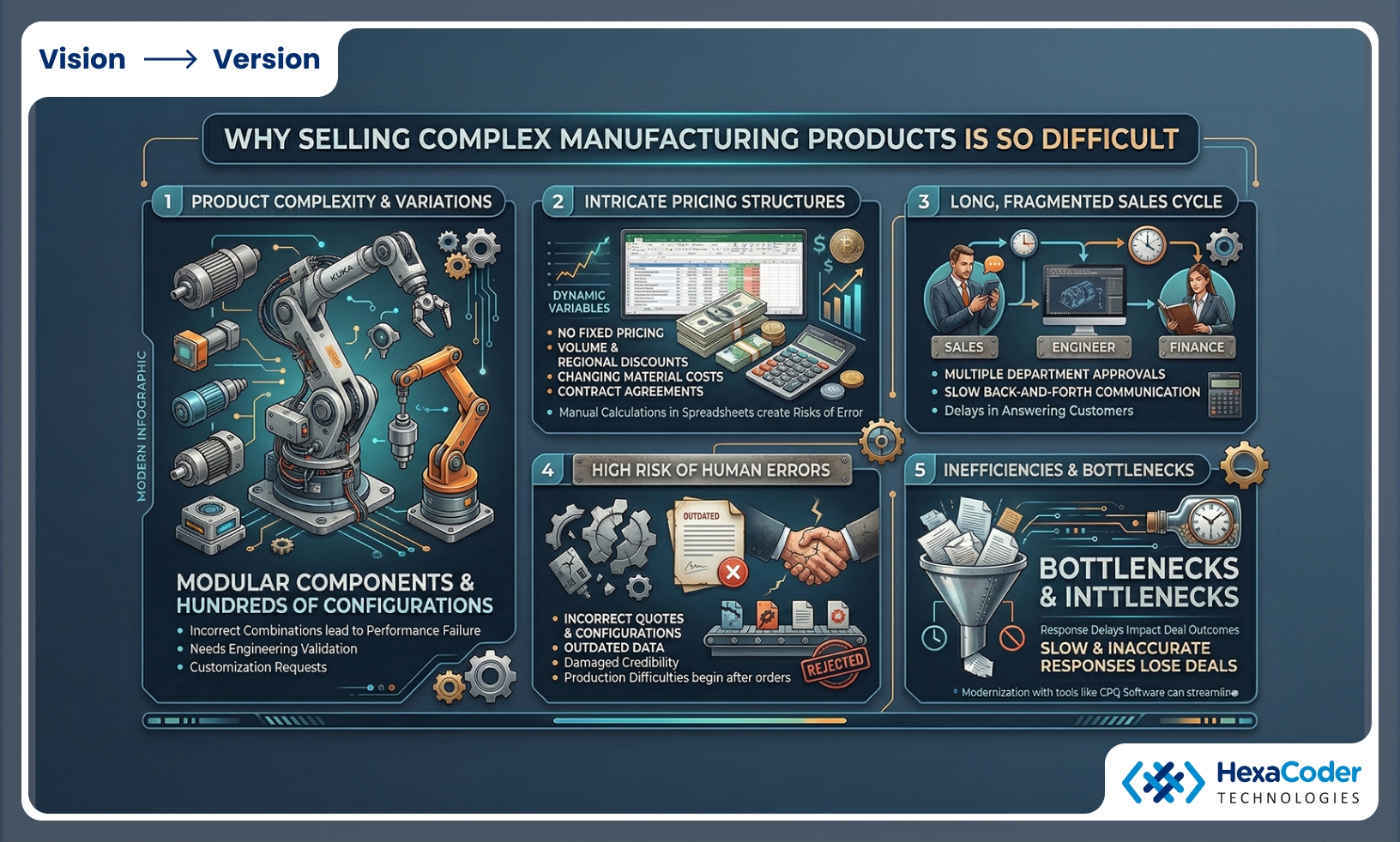
The process of selling complex manufacturing products requires different methods than selling standard products. A hidden system of technical specifications and customization requests and pricing rules and operational constraints exists behind each customer order. The process of completing what seems like a simple sale becomes a difficult procedure which needs multiple departments and several verification steps to finish. The sheer number of product variations represents one of the most significant challenges. The majority of manufacturing products use modular components which allow complete customization through hundreds of possible configurations. A machine might come in multiple sizes, power capacities, materials, and optional add-ons. The selection process determines which components will work together. The system becomes unworkable because selecting an incorrect combination will result in performance problems. Sales teams without established systems need engineering teams to check configuration viability which creates delays throughout the sales cycle.
Pricing adds another layer of complexity. The manufacturing pricing system does not operate according to fixed pricing which industrial companies use to establish their prices. The pricing structure includes volume-based discounts and regional pricing variations and contract agreements and changing material expenses. Sales representatives must compute margins while maintaining competitive quotes through manual calculations. The use of spreadsheets and internal documents by companies to finalize their prices creates a higher risk of making pricing mistakes.
The sales cycle itself can become painfully long. A customer inquiry might move from the sales team to engineering for configuration validation then to finance for pricing approval and sometimes back again for adjustments. The process of back-and-forth communication creates delays in answering questions which results in customer frustration because they want immediate responses.
People make mistakes which creates a risk that cannot be avoided. The presence of incorrect configurations together with outdated pricing data and missing documentation results in delivery of incorrect quotes. These errors damage credibility while creating production difficulties which begin after production starts.
Inefficiencies create a serious bottleneck for manufacturers who need to compete in fast-moving markets. The ability to respond quickly and accurately to customer requests often determines whether a deal moves forward or falls apart. The increasing complexity of operations drives many manufacturers to adopt CPQ software which helps them achieve streamlined and modern sales processes.
What CPQ Software Actually Does
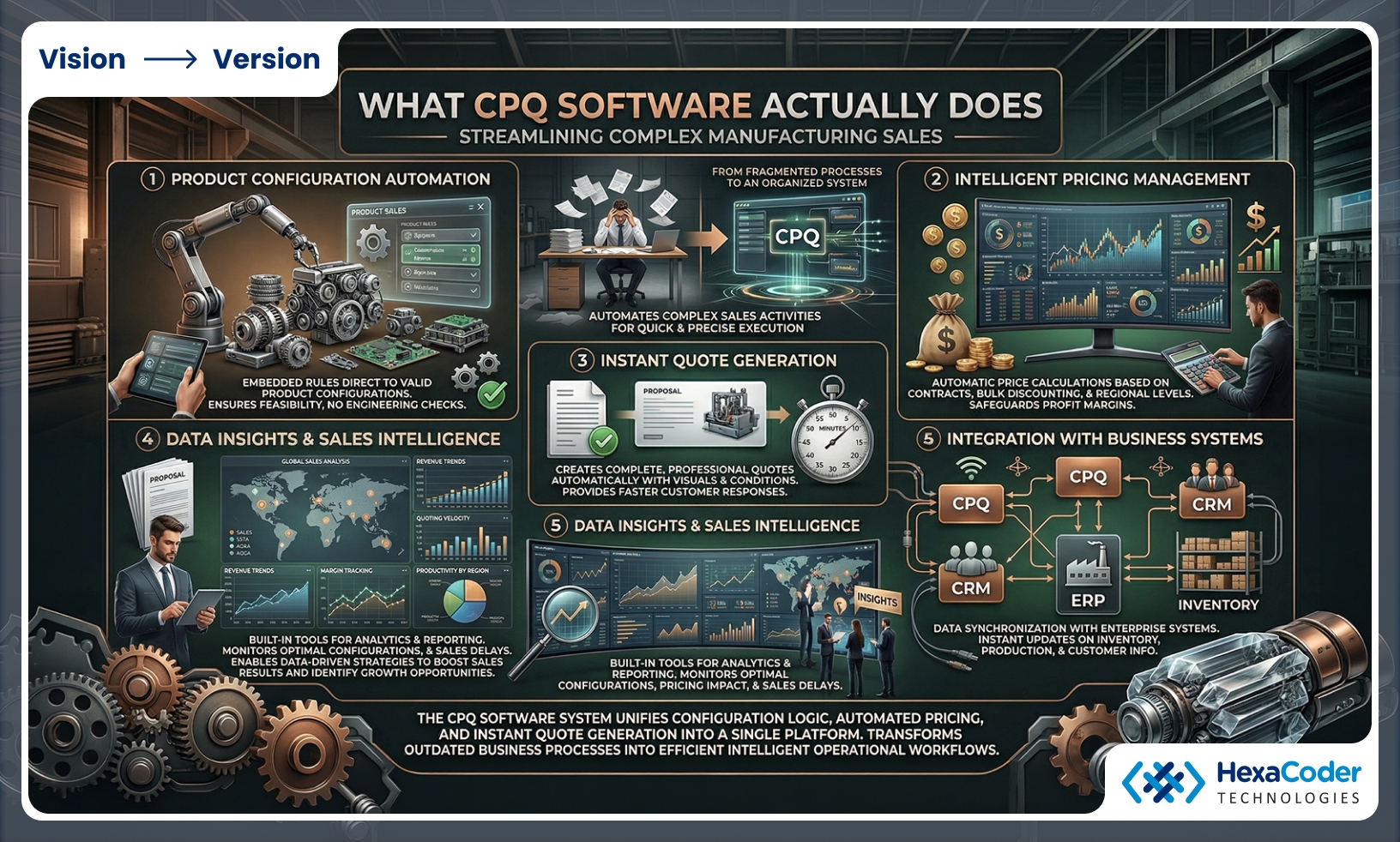
The process of making complex manufacturing sales requires multiple decisions about which configuration to choose and which price to set and which final offer to present to the customer. Organizations used to make these decisions through a process that required several departments to work together while using various documents throughout an extended time. All the steps in the process become part of one organized system through CPQ software. The system manages all sales activities through automated processes which enable quick and precise execution of configuration and pricing and quoting tasks.
The key functions of CPQ software create exceptional value for manufacturers who deliver complex products to customers.
1. Product Configuration Automation
CPQ software makes it easier to create advanced products through its product development capabilities. Manufacturing products usually require multiple parts and special design features which do not function when combined in every way. CPQ systems embed product rules directly into the platform which directs sales representatives toward valid product configurations. The system allows users to choose components while it automatically shows which options match and which options should not be selected together. The process requires no engineering checks because all configurations have been confirmed as technically feasible.
2. Intelligent Pricing Management
Manufacturers encounter complex challenges when they attempt to determine their product pricing. The process requires manufacturers to consider contract pricing together with bulk discounting and different regional price levels and their required profit margins. The software performs automatic price calculations according to established price calculation standards which it stores as predefined price calculation rules. The system uses current product configuration data to calculate new prices according to established pricing guidelines. This method maintains identical price values while safeguarding profit boundaries and decreasing the chances of both undervalued prices and expensive business errors.
3. Instant Quote Generation
CPQ platforms create complete quotes automatically after users complete product configuration and pricing selection. The documents contain product details and price information together with the contractual conditions and product visual displays. Sales teams can create professional proposals within minutes because they no longer need to create documents through manual work which enables them to provide faster customer responses.
4. Integration with Business Systems
CPQ platforms work together with enterprise systems which include CRM and ERP and inventory management systems. The system establishes product data complete with customer details and operational information to maintain constant data synchronization. Sales teams receive instant updates on inventory levels and production capabilities together with customer information which enables them to create precise and trustworthy pricing estimates.
5. Data Insights and Sales Intelligence
Many CPQ platforms come with built-in tools for analytics and reporting. These systems monitor which configurations receive the highest usage and which pricing choices impact profit margins and which areas of the sales process experience delays. The information enables manufacturers to enhance their product lines and create better pricing methods and boost their total sales results.
The CPQ software system unifies three components configuration logic automated pricing and instant quote generation into a single platform which transforms outdated business processes into efficient intelligent operational workflows.
Key Ways CPQ Software Streamlines Manufacturing Sales
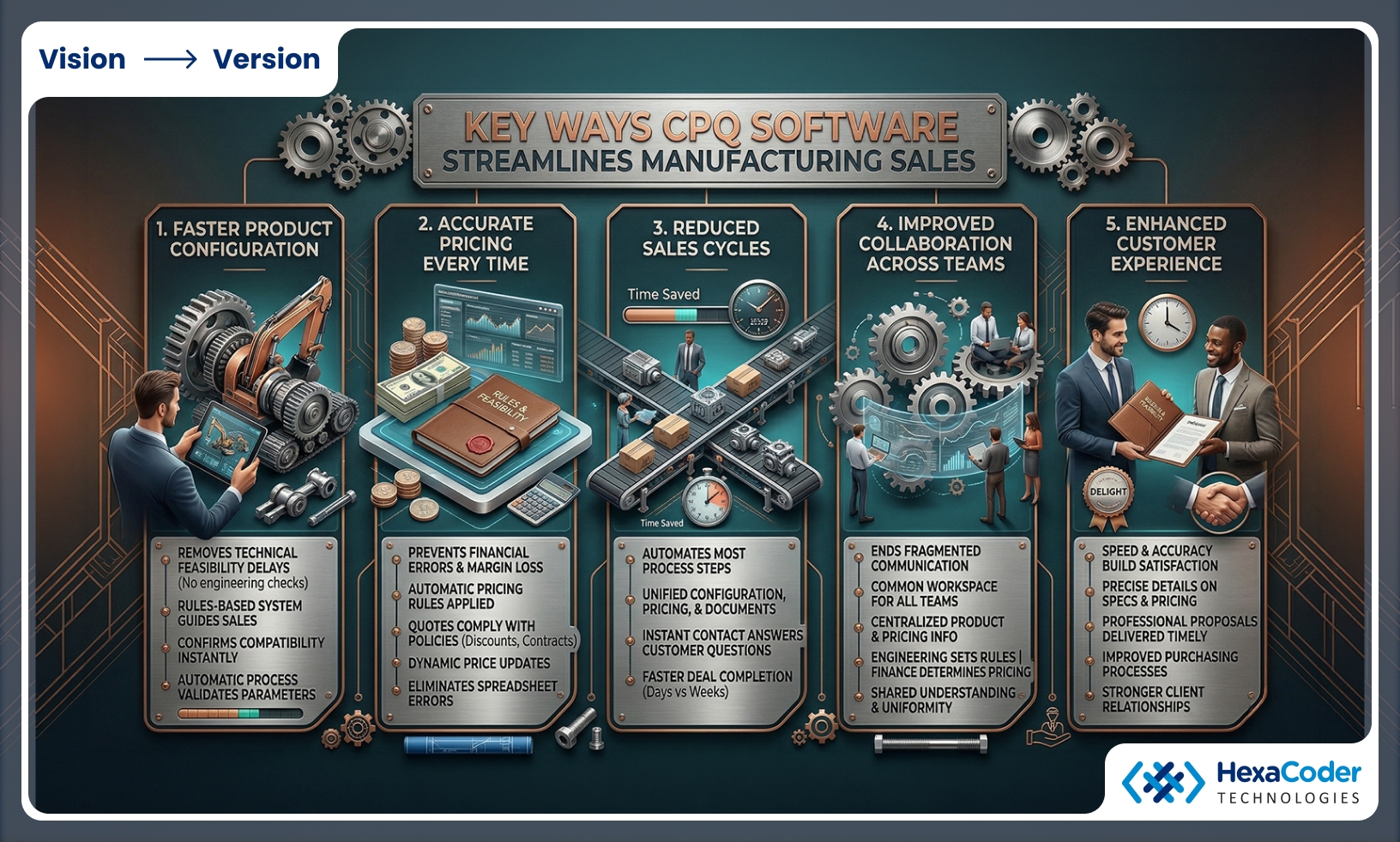
The software system delivers visible results starting from the moment it becomes operational. The system enables organizations to automate their processes, which used to depend on email communication and spreadsheet usage and manual approval methods. Sales teams receive tools that help them manage product complexity, which enables them to achieve faster deal completion times because they can better control the sales process.
CPQ software provides essential advantages which completely change how sales teams operate when selling complex manufacturing products.
1. Faster Product Configuration
The process of confirming technical feasibility for product configurations requires significant time from manufacturing sales teams. The sales team needs to reach out to engineers, who must confirm whether the components can work together, which creates delays in responding to customers.
CPQ software removes this barrier through its system design, which includes configuration rules as system components. The system directs sales teams through their work by providing them with specific options and tools for checking product compatibility. The platform establishes valid combination parameters through its automatic process, which restricts access to unapproved combinations. The sales representatives can develop intricate product designs through customer discussions, which results in faster response deliveries.
2. Accurate Pricing Every Time
Manufacturers face major financial problems when they make pricing errors. Incorrect quotes may lead to reduced margins, contractual disputes, or lost credibility with customers. The sales teams struggle to maintain pricing consistency because they depend on manual pricing calculations.
The software CPQ uses pricing rules which it applies automatically to all product configurations. The system includes built-in elements which guarantee that all quotes comply with company policies through discounts and contract pricing and margin threshold limits. The system provides immediate price updates when customers make changes to their product configurations. The system helps manufacturers maintain their competitive edge while eliminating spreadsheet errors which would affect their profits.
3. Reduced Sales Cycles
The traditional quoting process requires multiple departments to participate in the process. The sales team collects product information, while engineering assesses the configuration, and finance evaluates the pricing, before managers give their final approval. Delays in the sales process occur because each step needs time, which can extend the sales period from several days up to multiple weeks.
CPQ software automates most steps of the process. The platform handles all three processes of configuration validation, pricing calculations, and document generation. The sales team uses instant contact methods to answer customer questions, which leads to faster completion of the sales process from beginning conversations until finalizing the deal.
4. Improved Collaboration Across Teams
The process of manufacturing sales requires input from engineering and finance and operations departments to succeed. The absence of a centralized system results in teams experiencing fragmented and inefficient communication.
The CPQ platforms establish a common workspace where all users access identical product information and pricing standards and configuration rules. The engineering team establishes product rules while the finance team determines pricing standards which the sales force uses to create precise quotations. The process establishes shared understanding between departments which helps maintain uniformity in information throughout the organization.
5. Enhanced Customer Experience
The speed and accuracy of service delivery establish fundamental requirements for achieving customer satisfaction. Buyers who request customized products demand precise details about product specifications and pricing and delivery schedules. Customers will lose trust when they receive extended waiting periods or incorrect pricing estimates which will lead them to choose competitor products.
Sales teams use CPQ software to generate professional proposals which they can deliver to clients in a timely manner. The system provides customers with correct configurations and clear pricing information and quick delivery times. The company achieves both improved purchasing processes and stronger client relationships through its high-speed response system.
The CPQ software streamlines sales operations by eliminating manual work obstacles and unifying team members through a single system. The manufacturing process enables companies to achieve faster operations while decreasing mistakes and delivering customer service that meets current market needs.
How CPQ Turns Product Complexity Into a Sales Advantage
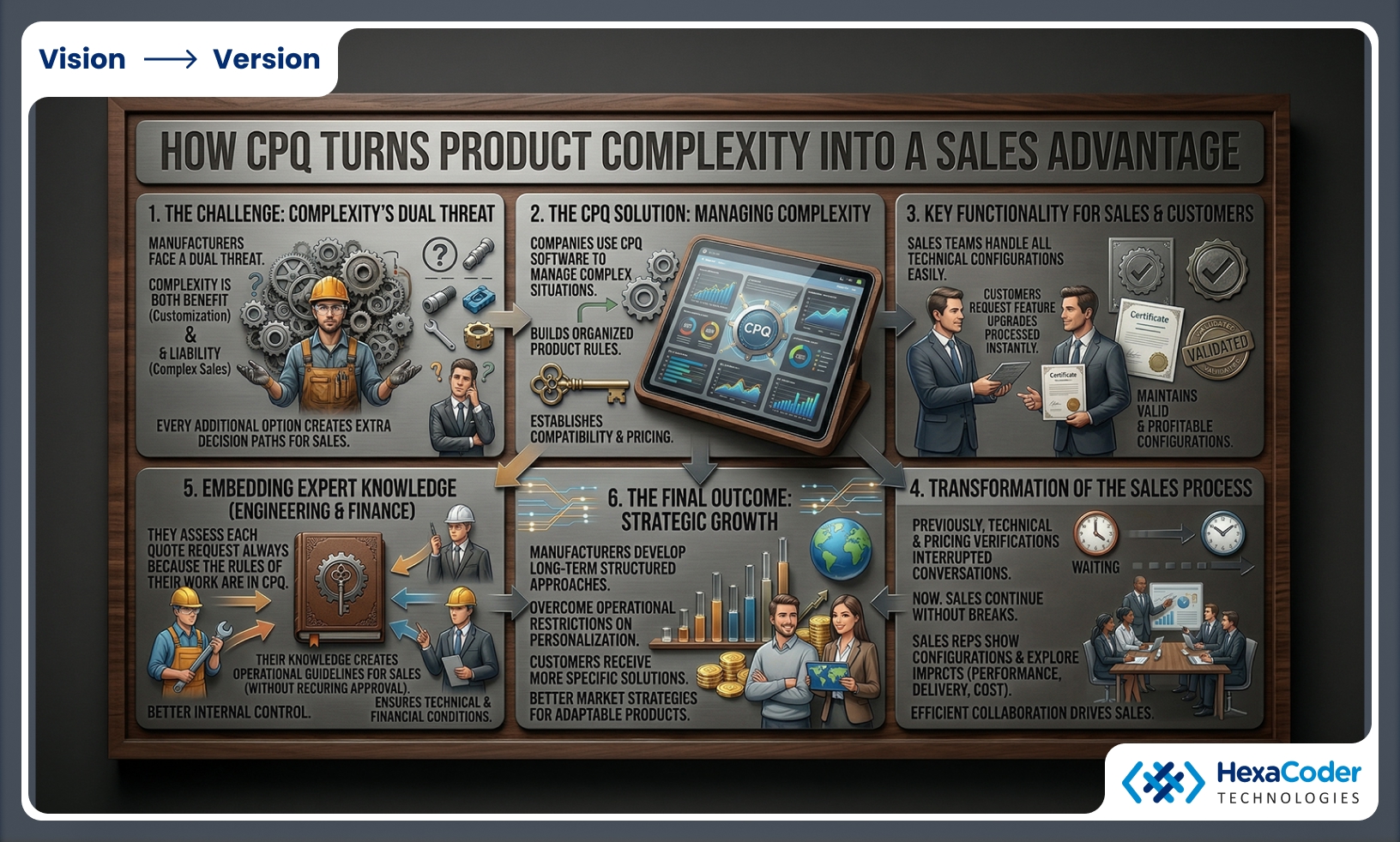
Manufacturers face a dual threat from product complexity because it functions as both a benefit and liability. Companies can create distinct market advantages through their ability to customize products according to exact client needs. Every additional option which customers select from materials and performance specifications to modular components creates extra decision paths which sales personnel must navigate. The sales process becomes more difficult because complex situations require specific tools which help sales teams and customers throughout the entire deal process.
Companies use CPQ software to manage complex business situations. The system builds organized product rules which create compatibility restrictions and establish pricing structures instead of treating customization as a logistical problem. Sales teams can use this system to handle all product configurations which require advanced technical knowledge. The system enables customers to request feature upgrades which get processed instantly while maintaining valid and profitable final product configurations.
The sales process undergoes a major transformation because of this change. Technical verification and pricing calculations used to interrupt conversations which now continue without any breaks. Sales representatives use the system to show customers different product configurations while they explore how each configuration choice impacts performance and delivery and cost. The sales process becomes more efficient because collaborative work helps people discuss customizations which drive the sale.
The establishment of engineering and finance teams requires their presence at all times to assess each quote request because the established rules of their work have become part of the CPQ system. The system uses their specialized knowledge to create operational guidelines which sales personnel can use without needing to seek their approval. The process establishes better control over internal operations while ensuring that all quotes meet the organization's technical requirements and financial conditions.
Manufacturers develop new methods to assess product complexity through their structured approach which they implement over an extended period. Companies can now provide more flexible solution options because operational problems no longer restrict their ability to personalize products. Customers receive more specific solutions which allow manufacturers to develop better market strategies that meet the increasing demand for adaptable products.
Key Features to Look for in Manufacturing CPQ Software
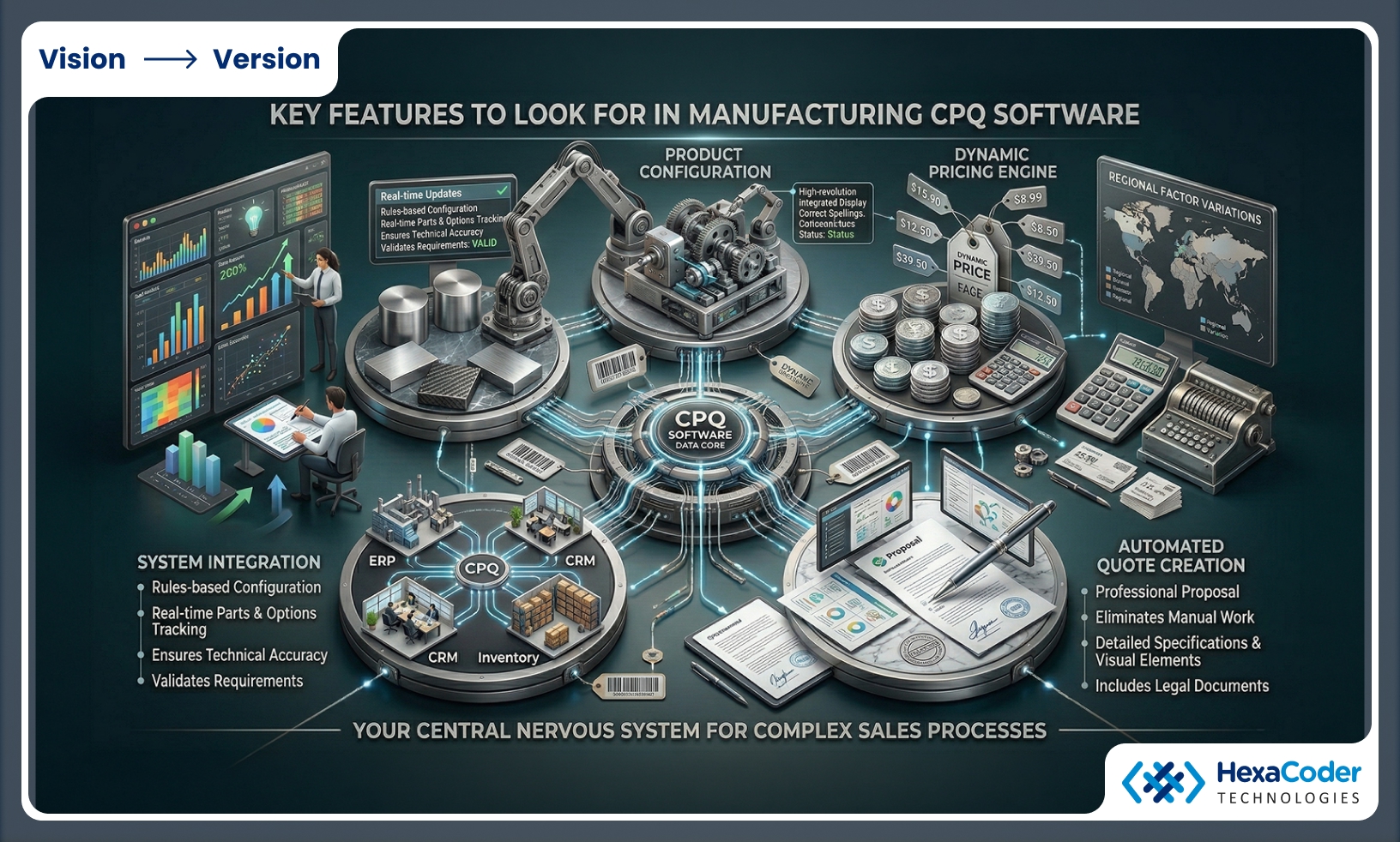
The selection process for CPQ platforms requires careful evaluation because different systems offer different levels of automation and sales process improvement. The essential capabilities of CPQ software require manufacturers to have specific functionalities when they work with intricate products. The primary system capability enables users to create product configurations through the application of predefined rules. The system needs to track which parts and options and materials exist in the system so it can check in real time which configurations meet requirements. The sales team depends on this feature because they need to create accurate quotes that meet technical and financial requirements. The system requires a dynamic pricing engine as its critical component. The manufacturing industry uses various factors to determine prices because fixed pricing systems do not work for materials and customizations and volume and regional factors. The CPQ software needs to calculate prices immediately while applying rules and discounts through all quotes whenever a user wants to quote an item. The ability to automate quote creation transforms business operations. The software needs to create professional proposals for customers after users set configuration and pricing details without requiring any manual work. The documents contain all necessary elements for a customer complete experience because they include detailed specifications and pricing information and visual elements and legal documents.
The equal importance of integration needs to be recognized alongside the need for functional capabilities. The best CPQ platforms connect seamlessly with ERP systems, CRM tools, and inventory databases, which enables accurate and synchronized product data and pricing information and availability details. Using real-time operational data sales teams can create accurate product quotations which decrease both errors and delays in their work process.
The combination of analytics with reporting capabilities enables manufacturers to track their performance while identifying the most popular configurations which helps them establish effective pricing methods. The tools enable companies to transform data into actionable insights which help them make better business choices while speeding up their sales processes and sustaining their market competitiveness.
The appropriate CPQ software functions as a central nervous system for complex sales processes according to the needs of organizations which require assistance with their configuration and pricing and proposal development tasks which need to maintain their operational efficiency while meeting customer demands.
Unlocking the Full Potential of CPQ in Manufacturing
CPQ software has proven itself as a game-changer for manufacturers navigating the complexity of configurable products. The system solves its most severe sales process problems by automating product configuration and pricing which produces professional instant quotes. The system transforms sales efficiency through accurate performance improvement while decreasing time requirements and increasing team collaboration to deliver superior customer service.
The basic benefits of CPQ provide manufacturers with three advanced abilities through its integration with ERP and CRM systems and its capability to track inventory and deliver analytical data. The system enables manufacturers to make better decisions through its ability to forecast demand and create operational efficiency across their business operations. The development of CPQ platforms now features AI-based recommendations which help users create their sales strategies through guided selling methods and 3D visualizations that simplify complicated product configurations.
The CPQ software product streamlines the sales process and uses complex systems to create a market advantage for businesses. The system enables manufacturers to improve their response speed and selling efficiency while achieving operational growth through providing customers with accurate and professional service. The CPQ system has become essential for contemporary manufacturing because it provides precise and fast products which customers can personalize according to their preferences.