
Best Digital Twin Technology Example
The room is quiet, and something is not right.On a massive screen, a turbine within a power plant is vibrating in a way that it should not. The engineers lean in, observing numbers as they climb. Temperatures increase, and pressure shifts. It has not failed yet, but it will.
However, the turbine that they are observing is not the real turbine. It is a digital twin. A living, breathing digital copy of the real turbine, which is operating hundreds of miles away. Within minutes, the system will not only tell them which component will fail but also the timing of the failure, as well as the solution, before the very first bolt even loosens on the real-world turbine. The solution is implemented, and the failure is averted, all before it has even occurred.
For decades, the world has operated in a state of blindness. Machines fail without warning, and cities have grown without foresight. Complex systems have been operated based on experience, guesswork, and delayed feedback. This is where digital twin technology has altered things. Rather than simply waiting for things to go wrong and then trying to fix them, organizations now have the chance to observe, test, and predict reality. This means that entire factories, aircraft engine systems, and even cities now exist in two places at once: in the real world and in a virtual world. And this is changing things for good.
In today's world, digital twin technology is being used by organizations across different industries to simulate complex asset behavior and gain insights into real-time performance. This would have been impossible to do just a decade ago. Digital twin technology is becoming one of the most powerful tools for organizations to make decisions and innovate in fields like aerospace engineering, healthcare systems, and smart cities.
In this article, we will look at some of the best digital twin technology examples and see how different organizations around the world are using digital twin technology to predict failures and improve their systems because once the physical world has a digital reflection, things will never be seen in the same way again.
What Is Digital Twin Technology?
The data used for your training was collected until the month of October in the year 2023. Digital twin technology creates a virtual duplicate which continuously replicates the current state of its actual physical object or system or process.
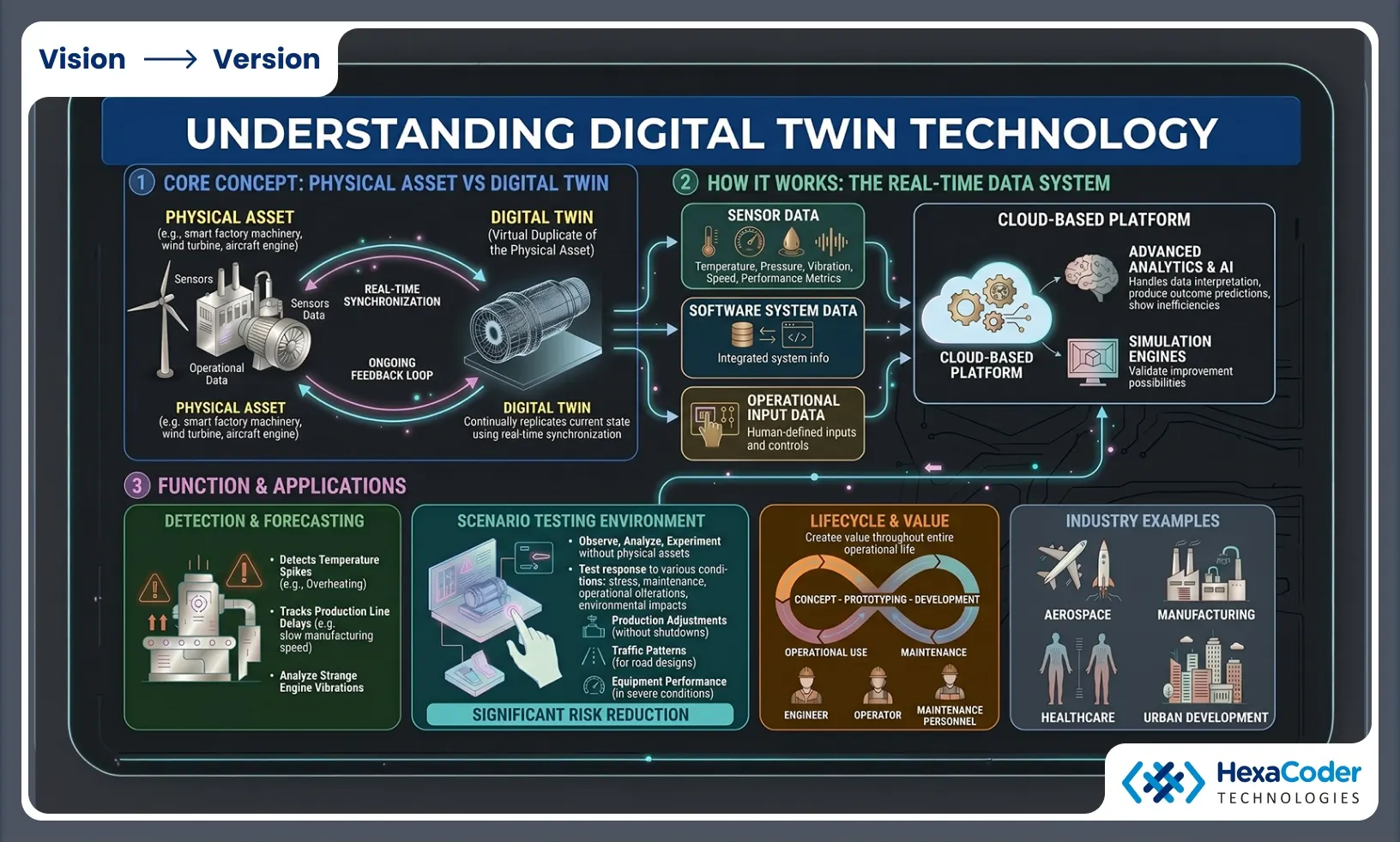
The digital twin represents more than just a basic 3D model with a fixed simulation. The digital twin functions as a system which receives real-time information from three different sources: sensor data and software system data and operational input data. The digital model uses real-time data to create an identical digital twin of the actual physical object. The physical system undergoes modifications which trigger corresponding alterations in the digital twin. The twin detects temperature spikes which occur when a machine reaches overheating conditions. The twin system tracks the production line delays which occur when manufacturing operations decrease their running speed. The twin system detects strange engine vibrations which occur during aircraft engine operations and uses this data to forecast potential results. The continuous synchronization process creates a digital model which operates as an active real-world representation.
Digital twins operate through the combination of multiple fundamental technologies which function as interconnected components. Sensors installed in physical equipment capture operational information about their current temperature and pressure and vibration and speed and performance metrics. The system sends this information through IoT networks to cloud-based systems which handle data processing and analysis. Advanced analytics together with artificial intelligence and simulation engines handle data interpretation to produce outcome predictions and show existing inefficiencies and validate improvement possibilities.
The system provides engineers and operators and decision-makers with a tool for observing and analyzing and experimenting without physical contact with the actual system. Organizations can first execute scenario tests inside the digital twin environment instead of waiting for real-world problems to emerge. The system enables them to test its response to various stress conditions and maintenance practices and operational alterations and environmental impacts. The capability produces significant risk reduction. Production adjustments at the factory can undergo testing without any need for machine shutdowns. Traffic planners can create simulations of traffic patterns to assess potential impacts before they implement new road designs. Energy providers can study equipment performance during severe conditions without endangering their actual operational facilities. The digital twin functions as a protected testing space for intricate systems. Digital twins create value throughout their entire operational life. The process of creation begins with design and continues through development until final implementation. The physical asset starts its evolution from initial concept through prototyping before it enters operational use and undergoes maintenance activities and system upgrades. Digital twins accomplish several functions at the same time. The system provides engineering support for design work while it enables operators to track their daily tasks and maintenance personnel to forecast equipment breakdowns.
The ongoing feedback system between physical locations and digital spaces enables organizations to achieve insights which standard monitoring systems cannot deliver. The foundation needs to be understood first before the real-world examples can be studied. The true power of digital twin technology becomes clear when you see how companies are applying it to solve complex problems in industries like aerospace, manufacturing, healthcare, and urban development. Most people do not understand the full extent of some applications which exist within that field.
Why Digital Twin Technology Is Becoming So Important
The testing approaches of industries have depended on physical experiments and past records together with their manual observation methods for system performance evaluation since the mid 20th century. Engineers created prototypes while companies used a machine failure pattern to decide when to implement repairs and city planners relied on incomplete future forecasts to guide their decisions. Digital twin technology is changing that model entirely. Organizations today use predictive capabilities to create system simulations which they optimize before real-world consequences occur. Digital twins have become necessary for multiple industries because their predictive intelligence function replaces traditional reactive decision-making systems. The main benefit of this technology lies in its ability to predict when equipment needs maintenance. Equipment maintenance practices follow two established methods: organizations schedule maintenance work or they complete repairs after machinery breaks down. Scheduled maintenance leads to unnecessary part replacements while equipment shows operational ability and reactive repair only starts after equipment failure disrupts the work process. The two methods create results which cost organizations money while their operations become less effective.
Digital twins create a better solution which brings more effective results. The system detects performance changes which lead to operational failure because it receives continuous data from actual assets-v2 throughout their service time. A turbine experiences future problems when its vibration level shows even minor increases and manufacturing machines display temperature differences and aircraft components encounter unusual stress patterns. Organizations can prevent severe operational interruptions by using early detection systems which help them solve problems before they develop into major disruptions.
The process of operational optimization provides another critical advantage to organizations. The factory system and energy grid system and transportation network system operate as complex systems which require management of thousands of interconnected elements. The modification of one component brings about changes to multiple other components. Engineers use digital twins to create simulations which allow them to test various interaction scenarios. Engineers use virtual environments to test multiple operational strategies and production schedules and infrastructure modifications while they monitor results in real time. The system allows companies to test different approaches without interrupting their current business activities.
The technology serves as a fundamental component for creating new products and developing existing products. Engineers use digital twins to create simulations of complex product development which includes aircraft and automobiles and industrial machinery during its development stage to test different operational scenarios before constructing physical prototypes. Engineers can replace the need for multiple costly test prototypes by using digital simulations to conduct thousands of virtual tests. The new process enables faster project completion because it decreases the time needed to finish development while it cuts manufacturing expenses.
The transformation becomes more significant in fields such as healthcare and urban development. Hospitals are starting to investigate the use of digital twins for medical devices and human organs to gain better insights about treatment results. Cities create digital models of their urban systems to enhance their abilities in traffic management and energy usage and environmental conservation. The uses of digital twins extend beyond the fields of manufacturing and engineering. The system is evolving into a basic technological element which enables contemporary societies to control intricate systems.
The digital twin technology market keeps expanding because of two factors which drive its development. The Internet of Things and Artificial Intelligence and advanced cloud computing platforms have created new ways to collect and process and analyze huge amounts of real-time data. The complete functionality of digital twins depends on their required supporting technologies. The system creates a continuous connection between physical and digital worlds through its dual functioning ability. Organizations find this capability highly useful because their operations now depend on advanced systems which connect multiple complex components. Companies want more than performance monitoring; they require complete understanding of their operations which includes future prediction and testing capabilities. Digital twin technology provides exactly that. The technology shows its real capabilities through real-world use cases which demonstrate its ability to change multiple industries.
Best Digital Twin Technology Examples Across Industries
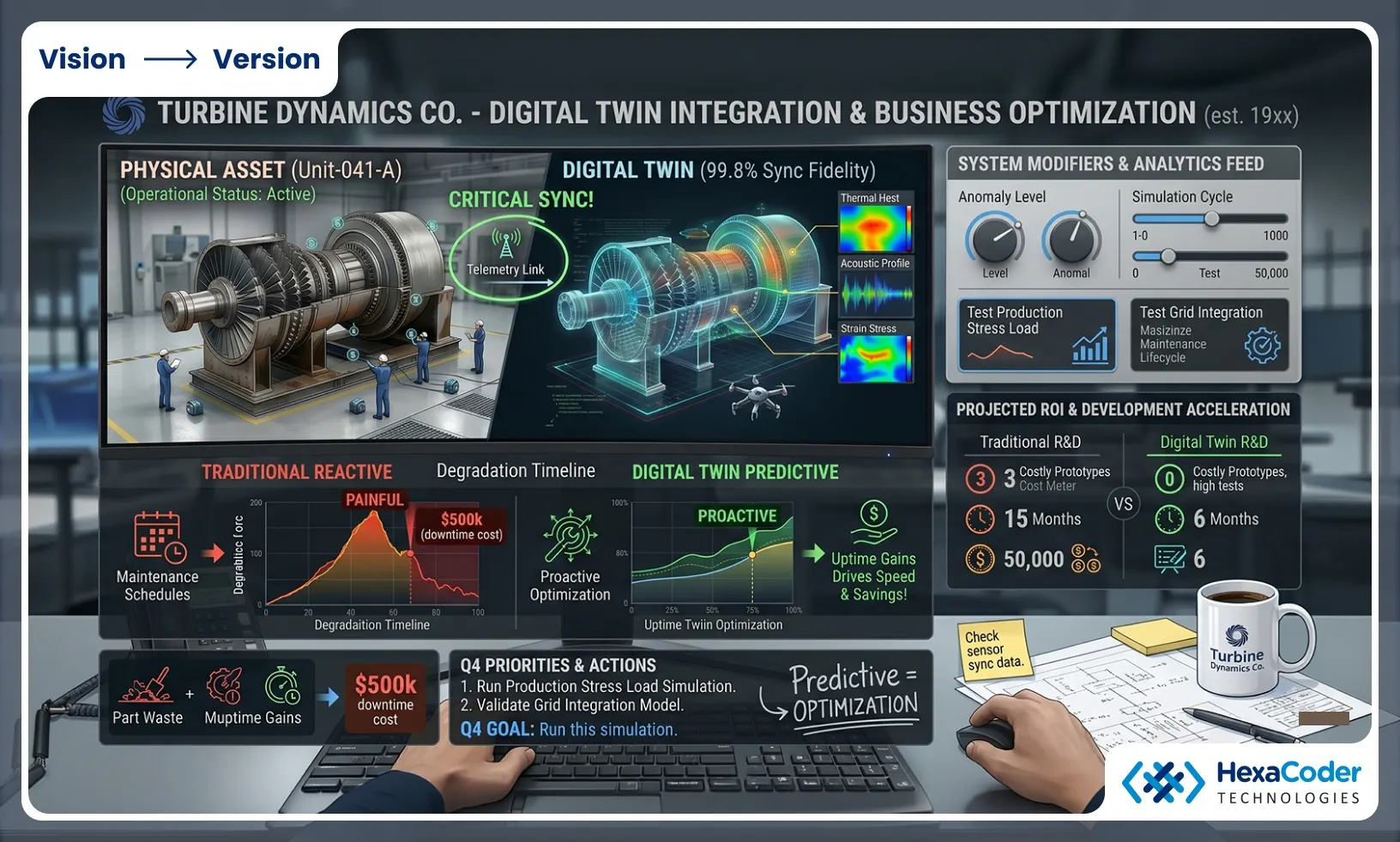
The actual worth of digital twin technology becomes evident when its theoretical concepts start to addressactual physical world challenges. Organizations across different industries create virtual duplicates of their equipment and facilities and entire operational spaces to enhance their performance while minimizing risks and making better choices. The strongest demonstrations of this concept originate from sectors that require total accuracy and complete operational dependability and maximum performance.
1. NASA – Digital Twins for Spacecraft Monitoring
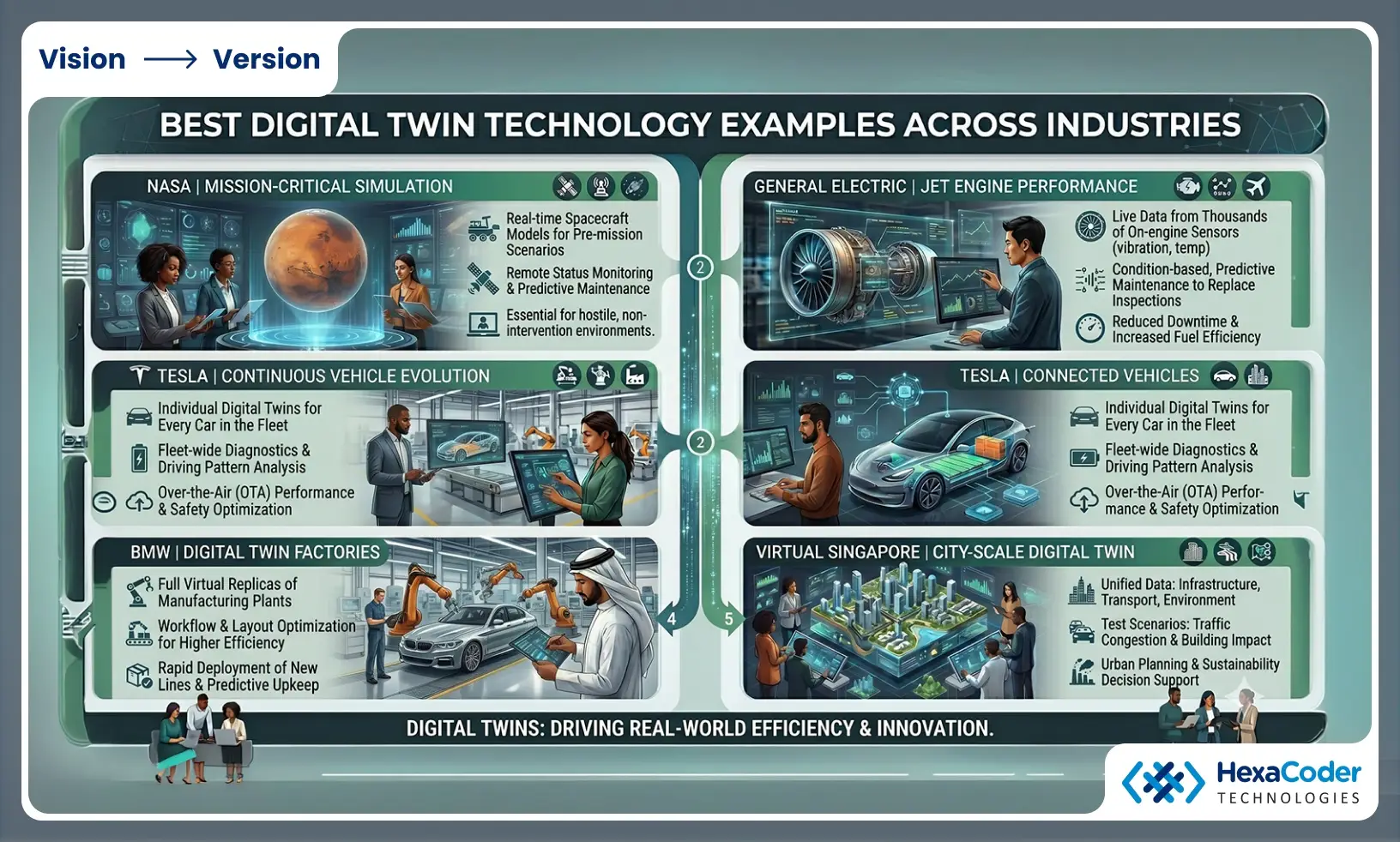
NASA implemented its own version of digital twin technology to track and simulate spacecraft operations before the term entered common usage. Space missions operate in extremely hostile environments where direct intervention is nearly impossible. Engineers use remote data as their only method to track activities occurring inside spacecraft systems which exist at distances of millions of miles from Earth. NASA developed virtual spacecraft system models which create real-time operational environments to solve this problem. The digital replicas permit engineers to run simulations for possible problems while testing solutions before they issue commands to the real spacecraft. NASA uses sensor data obtained from its onboard systems to track equipment status while identifying system problems and testing spacecraft parts under various operating environments. The system proves essential for missions that require equipment to maintain operational status throughout extended periods without receiving maintenance. Digital twins allow mission teams to assess equipment deterioration while they develop remote maintenance solutions and evaluate virtual model-based repair methods before executing them on actual spacecraft. The research environment demands this level of predictive accuracy because mistakes can create economic losses of billion-dollar value and destroy decades worth of scientific research work.
2. General Electric – Digital Twins for Jet Engine Performance
Digital twins have become essential to the aviation sector. General Electric developed advanced digital twin systems for aircraft engines which enable airlines and maintenance teams to monitor engine performance in real time. Modern jet engines generate huge amounts of operational data through their embedded sensors which monitor temperature, pressure, vibration, fuel efficiency, and mechanical stress. The system uses this data to create digital models which demonstrate how each engine operates. Engineers use continuous information analysis to identify early stages of material degradation and performance decline which happens before equipment fails. Airlines use actual engine condition data to perform specific maintenance instead of depending on scheduled inspections or emergency repairs. The benefits are substantial. Airlines achieve reduced downtime together with better fuel efficiency while they extend their expensive equipment lifespan. Digital twins provide predictive insights which manufacturers use to improve engine designs through testing component performance in actual operating environments.
3. BMW– Digital Twin Factories for Smarter Manufacturing
The rising complexity of manufacturing environments results from factories adopting automated systems together with robotic technologies and modern industrial equipment. BMW has adopted digital twins to enhance operational management of its production systems. The company created virtual replicas of entire factories, allowing engineers to simulate production processes before making physical changes on the factory floor. These digital twins help optimize manufacturing workflows by analyzing how machines, robots, and human operators interact during production. Engineers can test new assembly line configurations, evaluate equipment performance, and identify potential bottlenecks without interrupting ongoing operations. The digital twin system allows BMW engineers to create a virtual model of the complete production process for a new vehicle model which they will introduce to an existing factory. The team needs to optimize equipment layout and assembly steps and logistics before production actual production arrives at its starting point. The result is faster deployment, fewer disruptions, and more efficient factory operations.
4. Tesla – Digital Twins for Connected Vehicles
Tesla has developed digital twin technology to its most advanced state within the automotive industry. The digital twin system for each Tesla vehicle operates as a complete digital twin which gathers operational data from the vehicle to send it to Tesla's main operational centers. The system tracks battery performance and driving patterns and system diagnostics and environmental data. The digital twins enable Tesla engineers to track vehicle performance throughout their international vehicle fleet. The company utilizes data analysis from its vehicle fleet when it needs to solve problems which require pattern detection or defect assessment. Tesla uses remote software updates to address most technical issues without needing customers to visit service centers. The driving data from actual roads enables digital twins to enhance vehicle design and safety system development. The fleet data collection enables Tesla engineers to enhance self-driving technology and battery efficiency and overall vehicle performance.
5. Virtual Singapore – A Digital Twin of an Entire City
The application of digital twin technology extends beyond machine and factory environments because cities now develop complete digital models of their urban areas. Virtual Singapore stands as the most ambitious project because it creates a comprehensive digital twin of the city-state which unifies data from infrastructure systems and transportation networks and building structures and environmental monitoring devices. The digital model enables government agencies and urban planners and researchers to test various scenarios that demonstrate different city operational patterns. Planners investigate traffic congestion patterns while studying the impact of new buildings on wind flow and sunlight distribution and they test emergency response procedures for natural disasters. Environmental agencies track pollution levels to assess methods for achieving better sustainability outcomes. Decision-makers obtain advanced understanding of urban life through the dynamic digital city system which shows how infrastructure and policies impact urban environments.
What These Digital Twin Examples Reveal About the Future of Industry
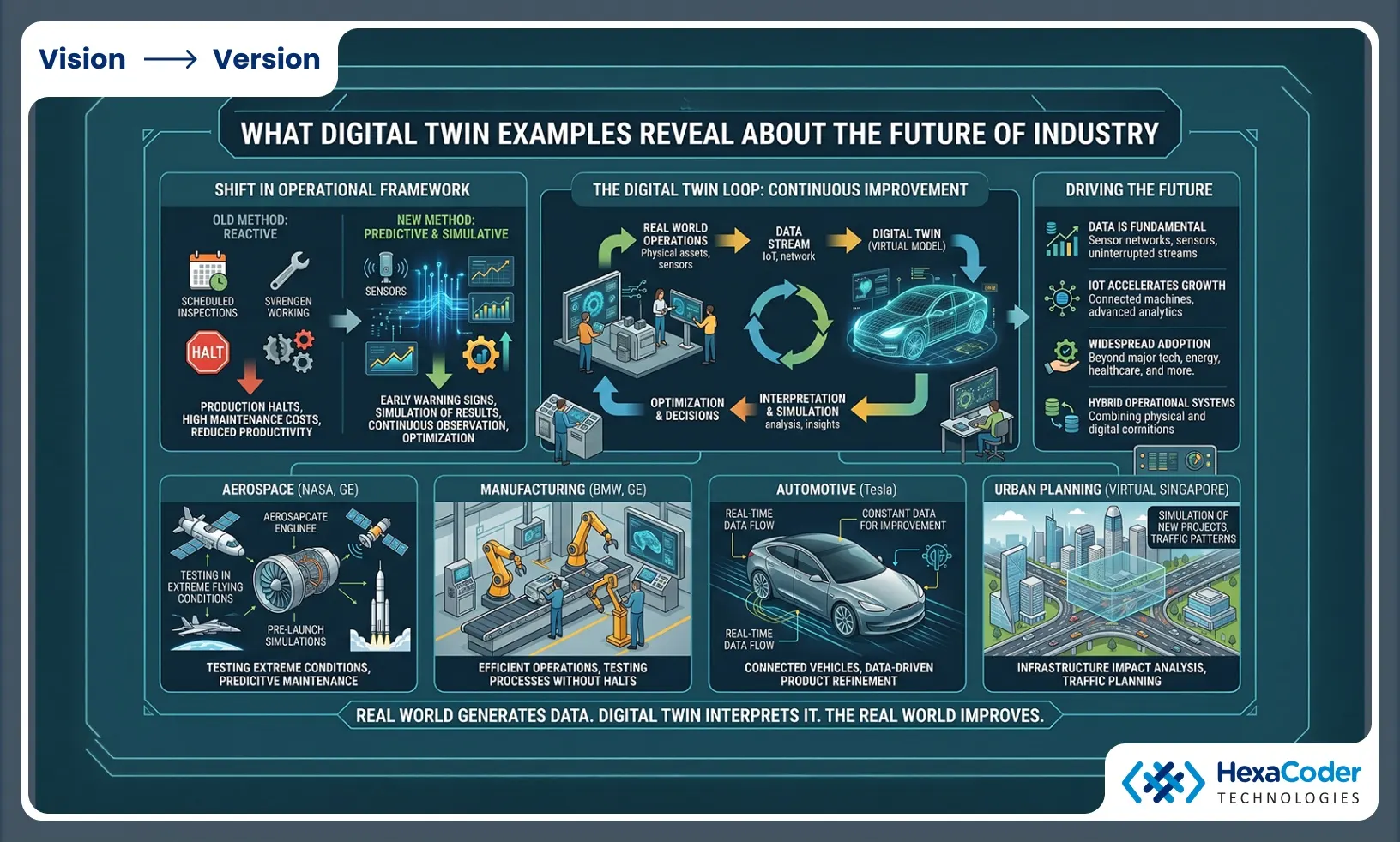
The combined analysis of these examples reveals an interesting pattern which becomes visible when observed from a distance. Digital twin technology functions as a machine monitoring tool which organizations use to develop their understanding of physical world operations. Digital twin technology is progressively transforming into a fundamental method through which organizations acquire knowledge about their physical assets-v2 and drive their operational enhancements.
Although NASA, General Electric, BMW, Tesla, and the Virtual Singapore project present different examples of digital twin technology their core principle remains unchanged. Spacecraft, jet engines, factories, vehicles, and cities operate in completely different environments. Yet the core idea behind each implementation is the same: creating a digital environment where real-world systems can be observed, tested, and improved continuously.
Digital twins create a new method for organizations to establish their operational decision-making process according to the two examples which demonstrate their potential. Many industries used to depend on scheduled equipment inspections together with historical data analysis and they would react when equipment problems occurred. Engineers would investigate the problem after it appeared to determine the cause of the failure. The main result from this method occurred through production halts which caused high maintenance costs and reduced workplace productivity. Digital twins create an entirely different operational framework for organizations to handle their business operations. Real-time system monitoring enables organizations to detect early warning signs while they simulate potential results which they need for their important decision-making processes about their business operations. Factory managers can test different production processes while the assembly line operates. A city planner can analyze how a new infrastructure project might affect traffic patterns before construction even begins. Aerospace engineers use testing methods to see how spacecraft parts will react under extreme flying conditions before their actual launch date.
Digital twins enable industries to change from their current operational style which requires them to react to situations into a new operational style which uses predictive methods and simulation tools for decision-making. The examples demonstrate that data is now fundamental to contemporary operations. Digital twins require an uninterrupted stream of data that comes from all sensor networks and device systems and their interconnected components. The data serves as the essential basis which enables precise simulation development and the extraction of valuable insights.
The development of digital twins will accelerate because more machines and systems and consumer devices now connect through Internet of Things technology. Digital twins become more advanced and beneficial for organizations because they will obtain access to better data resources and stronger analytical capabilities. The main point about digital twin technology shows that this technology exists beyond the boundaries of major technology firms and governmental bodies. The technology has become more widespread in various sectors because NASA and leading manufacturers used it to demonstrate its potential. Digital twins help manufacturing companies create more efficient operations through their use of these virtual models. Energy providers use digital twins to create power grid models which help them achieve better operational efficiency and system dependability. Healthcare organizations are using digital replicas to create advanced diagnostic tools which help with medical equipment testing and biological system analysis for treatment development.
Digital twins have changed from research projects into operational tools because both enhanced computing capabilities and increased data collection efforts. The current technological transition brings about a fundamental shift which affects the complete development process for industrial systems. Organizations now have access to hybrid operational systems which combine digital and physical components instead of depending on traditional methods of physical testing and manual observation. The real world generates data. The digital twin interprets it. The real world gets improved through the application of insights which decision-makers acquire. The observation simulation and improvement loop functions as the main strength of digital twin technology. The number of new applications will keep expanding because more industries discover its possibilities.
Key Lessons Businesses Can Learn from These Digital Twin Examples
The digital twin technology implementation in different industries demonstrates that successful companies achieve better results through their innovation activities because they use data-driven decision-making to address specific operational challenges. The following lessons serve as the most critical business takeaways.
Data Becomes More Valuable When It Is Visualized
Companies already collect massive amounts of operational data, but digital twins turn that data into something useful. Teams now have the ability to observe system performance through live system monitoring instead of analyzing static documents like spreadsheets and reports. General Electric uses digital twins to monitor their complex machinery which enables engineers to learn about engine performance and predict future problems.
Simulation Reduces Operational Risk
Testing changes on real-world systems can be expensive or dangerous. Digital twins allow companies to test their operations through virtual environments before implementing real-world experiments. NASA has used digital replicas of spacecraft systems to test scenarios since its existence because they help evaluate solutions before actual space missions.
Efficiency Improvements Become Easier to Identify
When companies create digital replicas of their production systems, they can identify operational problems more efficiently. The manufacturing company BMW uses digital twin technology to study their factory operations, which assists their teams in finding production delays and improving their manufacturing systems.
Predictive Maintenance Saves Costs
Digital twins enable organizations to forecast upcoming equipment failures instead of waiting for actual equipment breakdowns. Tesla and other automotive innovators use real-time vehicle data analysis to discover problems before they occur which helps them achieve reduced maintenance costs and downtime.
Better Planning for Complex Systems
Digital twins function as tools for sustaining extended planning processes. The Virtual Singapore project demonstrates how complete urban areas can be digitally modeled to evaluate various infrastructure and traffic and urban development strategies before actual physical changes take place.
The combination of these lessons shows that digital twin technology has developed into an essential strategic resource for contemporary businesses. Organizations gain better system understanding through this solution which enables risk-free testing and ongoing performance enhancements.
The Future of Digital Twin Technology
The most fascinating thing about digital twins is that we are still in the early chapters of the story. The current practices which various industries use to track machine operations and create factory simulations and assess vehicle capabilities only represent the initial steps toward achieving future technological capabilities.
Digital twin technology develops through the combination of increasing computing power and expanding usage of connected devices which transforms basic monitoring systems into advanced decision-making systems. Digital twins now possess the ability to forecast future developments which extend beyond their original function of monitoring current physical conditions. Artificial intelligence is playing a major role in this shift. The combination of artificial intelligence with digital twin models allows systems to process extensive operational data and deliver automatic system optimization recommendations. The manufacturing sector now uses production lines which have the ability to optimize their operations without human intervention. The logistics sector uses supply chains which can identify possible service interruptions before they take place.
Hexacoder Technologies develops digital twin systems which combine actual operational data streams with 3D interactive environments. The platforms enable organizations to monitor their assets-v2 and predict future results while assessing their operational efficiency without actual system interruptions.
The development of digital twins now extends beyond their previous application to machines and infrastructure. Researchers are creating digital twin systems which represent complete manufacturing systems and transportation systems and complete urban areas. The models enable planners to evaluate complicated situations through digital simulations before they implement actual solutions.
The integration of Industrial IoT is also accelerating this transformation. Sensors embedded in machines continuously stream operational data into digital twin platforms, ensuring the digital model remains synchronized with reality. This live connection allows organizations to detect anomalies, simulate adjustments, and optimize performance in real time.
What makes this shift particularly powerful is that digital twins are becoming more accessible. Cloud platforms, real-time rendering technologies, and scalable data systems are lowering the barriers to adoption, allowing companies of different sizes to implement digital twin strategies.
The result is a technology that is steadily becoming a core part of modern digital infrastructure. In the coming years, digital twins will likely become embedded in how industries design systems, monitor assets-v2, and plan operations. As organizations continue to blend physical environments with intelligent digital models, the line between the real world and its digital reflection will become increasingly seamless.
And in that new reality, digital twins will not simply visualize systemsthey will help organizations understand them, predict their behavior, and continuously improve how they operate. Digital twin technology is no longer just a futuristic conceptit is actively reshaping industries. Companies like Hexacoder Technologies are showing how real-time digital replicas can predict problems, optimize operations, and improve decision-making. From factories and vehicles to entire cities, digital twins turn complexity into clarity. As more organizations adopt this technology, the boundary between the physical and digital worlds will blur, creating smarter, safer, and more efficient systems for the future.